Global Logistics Lens - August
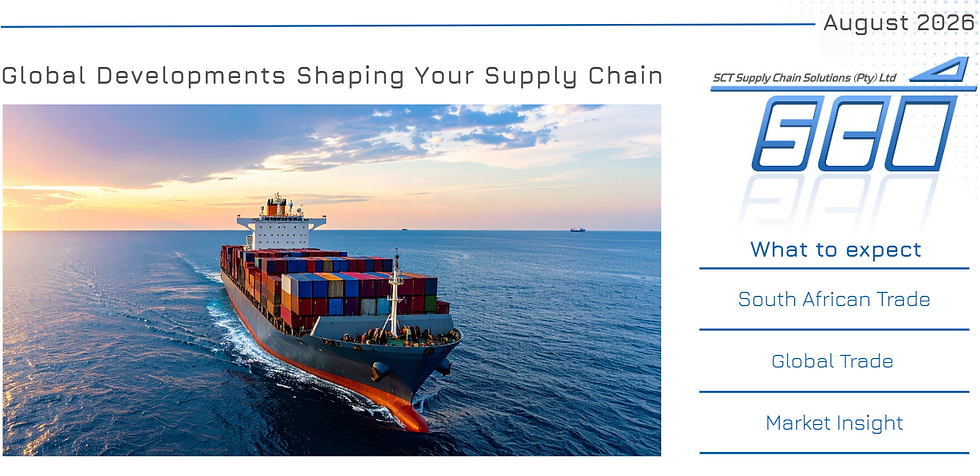
Global supply chains continue to adjust to a rapidly evolving trade environment, with new tariff measures, shifting shipping routes and improving regional logistics performance reshaping the outlook for South African importers and exporters. The confirmation of a 12.5% US tariff on most South African exports marks one of the month's most significant developments, while ocean carriers are cautiously expanding limited transits through the Suez Canal after many months of rerouting around the Cape of Good Hope. Despite these positive signs, ongoing geopolitical uncertainty in the Middle East means most services continue to favour the longer Cape route, keeping transit times and operating costs above historical norms. Closer to home, South Africa's logistics network continues to show encouraging progress. Durban remains one of the strongest-performing ports in the region, although recent equipment failures and adverse weather demonstrate that operational resilience is still evolving. Meanwhile, congestion at key regional border posts is increasingly becoming a greater source of supply chain disruption than the ports themselves.
As freight rates begin to stabilise and global trade patterns continue to shift, businesses that plan early, remain flexible and maintain visibility across their supply chains will be best positioned for the months ahead.
Key Highlights:
Durban's operational recovery remains strong despite isolated equipment failures and weather-related disruptions.
Congestion at Beitbridge and along the Maputo Corridor is placing increasing pressure on regional road freight.
SARS has extended safeguard duties on imported steel threaded fasteners.
Durban Gateway Terminal will implement its new NAVIS 4.0 operating system on 15 August.
US tariffs on most South African exports have increased to 12.5%, with selected agricultural products remaining exempt.
Maersk and Hapag-Lloyd continue cautiously expanding Suez Canal transits on selected services.
Uncertainty surrounding the Strait of Hormuz continues to influence carrier routing decisions and fuel-related costs.
Global container freight rates continue to ease, although new fuel-related surcharges are emerging.
Capacity constraints from India and congestion at Mediterranean transhipment hubs remain areas to watch.
This month's edition explores the developments shaping global supply chains and what they mean for South African importers and exporters as businesses prepare for the final quarter of the year.
South African Trade
South Africa's logistics sector continues to build on the operational improvements seen throughout 2026, with stronger port performance, increased throughput and ongoing investment supporting greater supply chain efficiency. While these gains are encouraging, recent events have highlighted that isolated equipment failures and inland transport constraints do still impact cargo movement. The focus is also beginning to shift beyond the ports. Border congestion at key regional crossings is becoming a more significant contributor to delays, reinforcing the importance of end-to-end supply chain planning rather than focusing solely on port performance.
Looking ahead, continued private-sector investment, infrastructure improvements and closer collaboration between industry stakeholders are expected to strengthen South Africa's logistics competitiveness. However, importers and exporters should continue monitoring both port operations and inland transport networks as operational conditions remain dynamic.
Port Operations:
Transnet recently recorded one of its strongest weeks in more than a decade, reflecting continued gains in vessel productivity and cargo throughput. Ongoing private-sector investment, including the planned expansion of Durban Container Terminal Pier 2, reinforces confidence in the long-term outlook for South African port infrastructure. Despite this positive momentum, late July highlighted that operational recovery is still evolving. Equipment failures and severe weather disrupted vessel schedules, resulting in service delays and a port omission by Maersk to protect its wider network schedule. While these disruptions were isolated, they serve as a reminder that terminal-specific issues can still impact cargo movement even when overall port performance remains strong.
Cape Town continues to experience seasonal weather-related disruptions typical of the winter months, affecting crane productivity and vessel schedules. At the same time, Transnet's plans to seek private-sector investment for the Cape Town Container Terminal signal a longer-term commitment to improving capacity and operational efficiency. At Coega, vessel waiting times remain variable, and importers should keep a close eye on current berthing schedules as delays are currently experienced. Exporters should also keep a close eye on Durban Gateway Terminal's reefer capacity, which reached approximately 95% occupancy during the peak citrus export season.
While terminals continue to operate effectively, high utilisation levels can place additional pressure on equipment availability and cargo planning during export peaks.
South African Port Performance Snapshot:
Port | Current Status | Outlook |
Durban | Strong throughput and improved vessel productivity. | Positive outlook, with equipment reliability remaining a key watch point. |
Durban Gateway Terminal | Equipment failures, weather disruptions and ongoing challenges securing port booking slots continue to impact cargo collections and vessel schedules. | Operations are expected to stabilise, but booking availability and schedule volatility remain key risks in the short term. |
Cape Town | Winter weather continues to affect terminal productivity. | Seasonal disruptions likely to continue until spring. |
Coega (Ngqura) | Vessel waiting times remain inconsistent. | Continue allowing flexibility when planning collections and deliveries. |
What this means: South African ports continue to perform significantly better than a year ago, but operational consistency remains more important than headline throughput figures. Importers and exporters should continue allowing contingency for disruptions and terminal-specific delays, particularly when shipping through Durban or Cape Town.
Durban Gateway Terminal NAVIS 4.0
Durban Gateway Terminal will implement its new NAVIS 4.0 Terminal Operating System on 15 August 2026. The new platform operates independently from Transnet's existing NAVIS system and requires all freight forwarders, transporters and shipping lines operating through DGT to be registered and familiar with the new environment before go-live. SCT has already started this process alongside our service providers to ensure a smooth transition at all levels.
Inland Logistics & Rail
As port operations continue to improve, inland transport is becoming the next major supply chain challenge. Border delays at Beitbridge increased significantly during late July, with congestion also affecting the Maputo Corridor and Martins Drift/Groblersbrug. These delays are placing additional pressure on regional road freight and extending transit times across Southern Africa. From 1 August, Botswana has introduced mandatory "Proceed to Border" customs pre-clearance for commercial road freight, requiring declarations to be completed before vehicles travel to the border. Rail performance continues to improve gradually but remains inconsistent, with the majority of containerised cargo still moving by road.
Compliance & Customs
Trade compliance remains one of the fastest-changing areas of international logistics. The US has confirmed a 12.5% tariff on most South African exports under its Section 301 trade measures, replacing the temporary 10% tariff that had applied over recent months. Selected agricultural products remain exempt.
Locally, SARS has extended safeguard duties on certain imported steel threaded fasteners, while the proposed Pre-Export Verification of Conformity (PVoC) program remains suspended pending further consultation. Businesses trading internationally should continue monitoring regulatory developments closely, particularly where tariffs or product-specific duties may affect landed costs.
Global Trade
Global shipping networks remain in a period of cautious transition. While selected carriers have begun reintroducing Suez Canal transits on certain services, most continue routing vessels around the Cape of Good Hope as geopolitical risks in the Middle East remain unresolved. For South African importers, longer transit times should still be considered the planning baseline. Elsewhere, congestion is becoming increasingly concentrated at key transhipment hubs rather than destination ports. Capacity constraints out of India continue to result in cargo rollovers and extended lead times, while Mediterranean hubs including Sines, Algeciras and Las Palmas continue working through vessel backlogs. In the Gulf, delays at Jebel Ali and Fujairah remain elevated as carriers adjust network schedules. Carriers continue to monitor conditions in the Red Sea and Strait of Hormuz closely, meaning routing decisions could change quickly should regional security improve or deteriorate.
What this means
Global shipping schedules remain fluid. Businesses should continue allowing additional transit time for shipments moving via transhipment hubs and maintain early booking practices to minimise rollover risk.
Global Port Performance Snapshot:
Region | Port | Status | Current Watch |
China | Shanghai | 🔴 Elevated | Congestion, vessel bunching and weather-related schedule recovery continue to impact departures. |
China | Ningbo | 🟠 Watch | Peak season volumes causing berth delays and reduced schedule reliability. |
Singapore | Singapore | 🟠 Watch | High transhipment volumes creating moderate congestion. |
South Korea | Busan | 🟠 Watch | Congestion at selected terminals continues to affect vessel schedules. |
India | Nhava Sheva & Mundra | 🔴 Elevated | Capacity constraints, cargo rollovers and limited vessel space remain key risks. |
Sri Lanka | Colombo | 🟠 Watch | Middle East cargo diversions continue placing pressure on transhipment operations. |
Netherlands | Rotterdam | 🟠 Watch | Inland transport constraints and schedule recovery continue to affect operations. |
Belgium | Antwerp | 🔴 Elevated | Berth congestion and high yard utilisation continue to delay vessels. |
Italy | Genoa & La Spezia | 🔴 Elevated | Congestion compounded by August factory holidays and reduced transport capacity. |
UAE | Jebel Ali | 🟠 Watch | Ongoing schedule disruption linked to Middle East network adjustments. |
Panama | Panama Canal | 🟡 Monitor | Transit restrictions ahead of forecast El Niño conditions may affect Q3 schedules. |
Global Watch
Typhoon activity along China's southern coastline may disrupt South China ports during early August, while Italy's annual summer shutdown (10–23 August) is expected to reduce manufacturing, trucking and terminal activity across the region. Importers sourcing from India should also continue planning for congestion, cargo rollovers and Peak Season Surcharges throughout August.
Global Freight Rates
Global container freight rates have softened for a second consecutive month following an earlier-than-normal peak season. While this is providing some relief for importers, the reduction is being partially offset by new Emergency Fuel Surcharges introduced by several carriers in response to ongoing tensions in the Middle East. Capacity discipline remains a key feature of the market, with carriers continuing to manage pricing through blank sailings and network adjustments rather than allowing rates to fall sharply.
Market Insights
Supply chain pressure is shifting inland: South African port performance continues to improve, but inland corridors and regional border crossings are increasingly becoming the primary source of supply chain delays.
Freight rates are easing—but costs remain unpredictable: Headline ocean freight rates continue to soften, yet fuel surcharges, geopolitical uncertainty and carrier capacity management continue influencing total landed costs.
Routing decisions remain fluid - Selected carriers are beginning to test a return to the Suez Canal, but the industry is far from a full recovery. With many shipping lines still favoring the Cape of Good Hope route, shippers should avoid assuming shorter transit times until a broader market shift is confirmed. Flexibility in planning remains essential as routing decisions continue to evolve.
Flexibility remains the competitive advantage: Whether responding to changing shipping routes, evolving compliance requirements or regional congestion, businesses that plan early and maintain supply chain visibility remain best positioned to minimise disruption.
Trade Lane Watch: What to Plan Around - Beyond the Red Sea and Suez, several trade lanes remain under pressure heading into August. India continues to experience capacity constraints, with congestion, cargo rollovers and Peak Season Surcharges affecting export shipments. In the Mediterranean, transhipment hubs including Sines, Algeciras and Las Palmas continue to experience vessel backlogs, adding uncertainty to cargo routed through the region. Businesses sourcing from or transhipping through Italy should also plan for reduced activity during the annual summer shutdown from 10–23 August, when many factories, suppliers and transport operators temporarily close. Meanwhile, the Panama Canal Authority has introduced transit restrictions ahead of a forecast El Niño event, which could affect shipments moving via the canal later in Q3.
SCT Logistics Intelligence View
South Africa's logistics landscape continues to move in the right direction, but risk is evolving rather than disappearing. While port performance has improved significantly, attention is shifting toward inland transport, changing trade regulations and global shipping network adjustments.
At SCT, we continue monitoring these developments in real time through our operational teams and the Scout customer portal, providing clients with greater visibility, earlier risk identification and proactive shipment management. In today's environment, timely information remains one of the most valuable tools in maintaining supply chain resilience.
Ready to see what others miss? Discover Scout by contacting SCT Supply Chain Solutions today.
Freight News
The following developments were among the most significant stories influencing global freight, supply chain performance and trade flows during July:
🚨 Market Disruptors
📈 Market Trends
🌍 South African Logistics
Sources & References
AfricaPorts/ African Mining/ BusinessTech/ Container Statistics+News/ Drewry/ DTIC/ Engineering News/ Flexport/ FreshPlaza/ Freight News/ FreightWaves/ GCaptain/ GoComet/ Hapag-Lloyd/ ICTSI/ iOL/ Linerlytica/ Loadstar/ Maersk/ Maritime Executive/ MSC/ Reuters/ SACO/ SAAFF/ Sea Advantage/ Sea Intelligence/ Seatrade Maritime/Transnet/ WeFreight / World Bank Container Port Performance Index / WorldCargo News / Xeneta